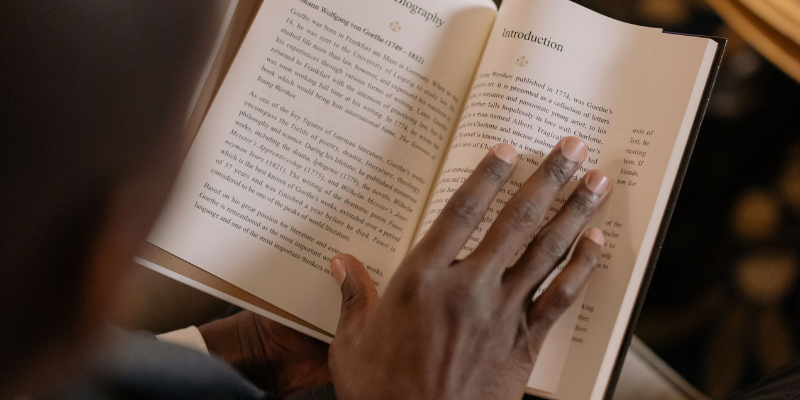
September is National Literacy Month, and it’s an opportunity to recognize a skill that many of us use so often that we rarely stop to think about it: the ability to read.
Think about how many times you rely on reading throughout a typical day. We read emails and text messages, signs and directions, news and information related to our work. When we have a question, reading gives us the ability to search for an answer. When we want to understand something more deeply, we can pick up a book and learn from someone else’s knowledge or experience.
Literacy is foundational to so much of how we navigate the world. It gives us the ability to communicate, access information, and pursue opportunities. But it also gives us something that I think is particularly important throughout our lives: the ability to follow our curiosity.
Reading Gives Us More Than Information
I have always enjoyed reading and learning, and for me, the two naturally build on one another.
When we read, we get to learn from someone else’s life, experiences, or point of view. But reading is rarely a one-way exchange. A new idea can lead us to think about our own experiences differently and begin asking questions we hadn’t considered before.
What does this mean for me? How could I apply this to something I’m working through? What else do I want to understand?
That is where curiosity comes in.
Leaders Have to Remain Learners
As we gain experience in our careers, there can be an expectation that we should have more of the answers. And while experience is valuable, I don’t believe reaching a certain level of leadership means we should ever stop being students.
Some of the habits I believe help us continue growing are relatively simple:
- Read beyond what you already know. Different perspectives can challenge the way you think about familiar problems.
- Ask questions even when you have experience. Curiosity doesn’t become less valuable as your career progresses.
- Be willing to become a beginner again. There will always be something we haven’t done, experienced, or learned yet.
I’ve experienced that last one firsthand.
Becoming a Student Again
After retiring from professional basketball and spending several years in an NBA front office, I decided to attend business school.
Throughout my playing career and the professional experiences that followed, I had encountered different aspects of business that interested me. Going back to school offered a more formal way to bring some of that knowledge together and continue developing in a different way.
I didn’t have a specific outcome mapped out. I hoped the experience would create new professional opportunities, but I didn’t know exactly what they would be. I also remember being nervous. It had been years since I had been in that type of formal learning environment.
But that was part of the reason I wanted to do it.
I was transitioning from one career into another, and I wanted to continue sharpening myself. I wanted to challenge myself, grow in a different way, and see if I could do it.
Sometimes learning requires us to step into a room where we aren’t the expert.
Curiosity Doesn’t Have an End Point
That desire to learn is something I still carry with me. I’m continually curious about people and teams.
- What makes certain groups successful?
- How do people who have accomplished meaningful things in different areas of life think and operate?
- What can their experiences teach us?
And then there are subjects where the questions seem to multiply faster than the answers.
Artificial intelligence is one of those subjects for me right now. We are already seeing its impact, but there is still so much we don’t know about how it will develop and what it will mean for the way we live and work.
I don’t think uncertainty is a reason to disengage from something. I think it makes it even more important to learn as much as we can.
Never Take the Ability to Learn for Granted
That’s what I find myself thinking about during National Literacy Month.
For those of us who have been reading for most of our lives, literacy can become almost invisible. We don’t think twice about being able to read an email, understand a document, search for an answer, or open a book when we want to learn something new.
But those everyday moments add up to something significant.
Literacy gives us the ability to:
- navigate more independently through everyday life;
- access information and opportunities;
- learn from people and perspectives beyond our own experiences; and
- continue developing new knowledge and skills throughout our lives.
Reading gives us access to a world far beyond what we can experience firsthand. Curiosity encourages us to keep exploring it.
No matter our age, career, or level of experience, there will always be something else to learn, another perspective to consider, and another question worth asking. We just have to remain willing to be students.
Leave a Reply